We present a curated snapshot of #RandomThoughts from our archives as a sense of purpose as we look forward to the privilege to serve:


We present the following #RandomThoughts On Those who've made a difference:
Soldier receives Purple Heart for a traumatic brain injury
Maj. Robert Morse recently received a Purple Heart for a traumatic brain injury that he sustained in 2020, an award from the Army that he never wished to get, but he is using it to help others. Read more.
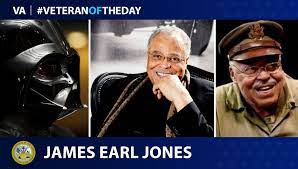
James Earl Jones – first lieutenant, United States Army
James Earl Jones served in the US military from 1953-1955. He was a member of the Pershing Rifles Drill Team and the National Society of Scabbard and Blade. Read more.

.png?upscale=true&name=MM_Stedman%20Graham_Part%202_1200x600%20(1).png)

With keen insight, Stedman Graham insists that to be a successful leader of others, you must first know how to lead yourself. In the second part of our conversation, he discusses the power of reinvention, overcoming insecurities, and how facing our past empowers us to be successful in the present.
If fear is holding you back in life, Stedman has some advice for you; having fears is normal but you can overcome them. The first step is deciding to be a victor and not a victim.
On this week's Motivational Mondays episode, Stedman shares more steps to successful leadership, including the importance of surrounding yourself with people who share your vision for success.

Whatever you think of him, it’s hard to deny that Napoleon achieved a historic level of greatness. Born, paradoxically, into both poverty and nobility on an island called Corsica, he managed, by the time he was only 34 years old to be the emperor of territories and client states stretching across much of continental Europe, Asia, South America and the Caribbean Sea. He won the battles of Austerlitz, Friedland, and Rivoli. He wrote laws and instituted reforms that, in some cases, stand even to this day.
How did he do it? What propelled him to achieve this level of glory and touch this kind of greatness—even if only for a moment? According to Louis Antoine Fauvelet de Bourrienne, Napoleon’s childhood friend and long-time aide, he rarely saw the first emperor of France not either pouring over books on strategy or planning the construction of statues. “Monuments pleased his imagination,” Bourrienne wrote in his famous Memoirs. To Napoleon, they were glory embodied. “Bonaparte well knew that the fine arts entail lasting glory on great actions, and consecrate the memory of princes who protect and encourage them.”
You can disagree—as the Stoics certainly would have—with Napoleon’s endless ambition and thirst for fame. What you cannot dispute is the power of the motivation that got him there, how he was spurred toward achievement through inspiration and conversation with the dead heroes of history.
In 1799, when Napoleon took up residence at the Tuileries, the royal palace, Bourrienne tells us of Napoleon’s first order of business.
He selected the statues of great men to adorn the gallery of the Tuileries. Among the Greeks he made choice of Demosthenes and Alexander, thus rendering homage at once to the genius of eloquence and the genius of victory. The statue of Hannibal was intended to recall the memory of Rome's most formidable enemy; and Rome herself was represented in the Consular Palace by the statues of Scipio, Cicero, Cato, Brutus and Caesar—the victor and the immolator being placed side by side. Among the great men of modern times he gave the first place to Gustavus Adolphus, and the next to Turenne and the great Condé, to Turenne in honour of his military talent, and to Condé to prove that there was nothing fearful in the recollection of a Bourbon. The remembrance of the glorious days of the French navy was revived by the statue of Duguai Trouin. Marlborough and Prince Eugène had also their places in the gallery, as if to attest the disasters which marked the close of the great reign; and Marshal Sage, to show that Louis XV.'s reign was not without its glory. The statues of Frederick and Washington were emblematic of false philosophy on a throne and true wisdom founding a free state. Finally, the names of Dugommier, Dampierre, and Joubert were intended to bear evidence of the high esteem which Bonaparte cherished for his old comrades,—those illustrious victims to a cause which had now ceased to be his.
Marcus said we should surround ourselves with great people so we can be showered in their virtues. Seneca said to “set as a guard over yourself the authority of some man,” someone “we regard as beyond the sphere of imitation.” Epictetus’s line was that we are constantly brushing shoulders with people covered in dirt—whose stench and stain do you want to wear?
We need heroes in our lives. We can see how effectively this worked in Napoleon’s life and still try to moderate it by selecting heroes that inspire us to be more just, less vain, less bloodthirsty. We look at a bust of a great leader like Marcus Aurelius on our shelf and remember that he was just a boy who read a lot of philosophy, and who ended up changing the world as a result. We can put up a bust of Seneca and use it as a reminder of the tension in that great man, use him as both an inspiration and a cautionary tale.
It’s up to you to decide who sits in your hall of heroes. It could be Abraham Lincoln or it could be Florence Nightingale. It could be Harriet Tubman, Nelson Mandela, Simon Bolivar or Charles De Gaulle. But you have to put them up and create reminders of them. In your mind. In your life. In your home.
Feel their presence. So you can live up to their example.

You may have missed it but in Meditations, Marcus Aurelius quotes dozens and dozens of other writers and philosophers. He just rarely attributes those quotes. Presumably, considering he wrote most of Meditations in a tent on a battlefield, he didn’t have his copies beside him when he was quoting Socrates or Epictetus or Homer or Plato. No, he was transcribing it straight from his memory.
This capacity for recall is indicative of the ancient’s approach to reading. The philosopher Mortimer Adler talked about how the phrase “well-read” has lost its original meaning. We hear someone referred to as “well-read” today and we think someone who has read lots of books.But the ancients would have thought someone who really knows their stuff, who has dived deep in a few classic texts to the point that they truly understand them. “A person who has read widely,” Mortimer says of the modern reader, “but not well deserves to be pitied rather than praised.” The early 17th century philosopher Thomas Hobbes joked similarly, “If I read as many books as most men do, I would be as dull-witted as they are.”
That’s why, as we talked about the other day, reading and rereading a select few works of a select few authors is so powerful. The insights that came from their minds gradually get permanently implanted in yours. It's not about reading the Stoics once but dozens, even hundreds of times. As Marcus would say, we can't be satisfied with just “getting the gist” of things you read. “Read attentively,” he said. Read deeply. Read repeatedly. Aim for quality, not quantity.
That's what it means to be well read. The test then is not whether you've read a lot...but what you have read a lot.
***